Construct Binary Tree from Preorder and Inorder Traversal
Problem Highlights
- 🔗 Leetcode Link: Construct Binary Tree from Preorder and Inorder Traversal
- 💡 Problem Difficulty: Medium
- ⏰ Time to complete: 25 mins
- 🛠️ Topics: Binary Trees, Depth First Search
- 🗒️ Similar Questions: Convert Sorted Array to Binary Search Tree, Binary Tree Preorder Traversal, Binary Tree Inorder Traversal
1: U-nderstand
Understand what the interviewer is asking for by using test cases and questions about the problem.
- Established a set (2-3) of test cases to verify their own solution later.
- Established a set (1-2) of edge cases to verify their solution handles complexities.
- Have fully understood the problem and have no clarifying questions.
- Have you verified any Time/Space Constraints for this problem?
- Can I expect to receive an empty Array as input?
- No, there may be at least one item in the array
- What is the time and space constraints for this problem?
O(n^2)worst-case time complexity for both implementations below (O(n)is possible with a hashmap index and index bounds in place of popping and slicing);O(n)space for the Java version, andO(n^2)worst case for the Python version, whose list slices stay alive on the call stack
HAPPY CASE
Input: preorder = [3,9,20,15,7], inorder = [9,3,15,20,7]
Output: [3,9,20,null,null,15,7]
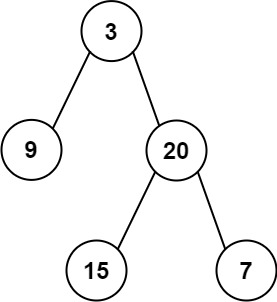
Input: preorder = [1], inorder = [1]
Output: [1]

EDGE CASE
Input: preorder = [-1], inorder = [-1]
Output: [-1]
2: M-atch
Match what this problem looks like to known categories of problems, e.g. Linked List or Dynamic Programming, and strategies or patterns in those categories.
If you are dealing with Binary Trees some common techniques you can employ to help you solve the problem:
- Think about appropriate Tree Traversal: Pre-Order, In-Order, Post-Order, Level-Order
- Since are traversing a binary tree. We should think about the order, and the order given is Pre-Order and In-Order
- Store nodes within a HashMap to refer to later
- We will need access to the inorder index as determined by value to split the left and right nodes. This will help us improve out time complexity.
- Using Binary Search to find an element
- We are not looking to find an element in this problem so this technique is not useful for this problem
- Applying a level-order traversal with a queue
- Since are traversing tree with the idea of returning a tree using Pre-Order and In-Order values. Level Order Tree Traversal does not apply very well here.
3: P-lan
Plan the solution with appropriate visualizations and pseudocode.
General Idea: Pre-Order traverse is process-left-right and In-Order traverse is left-process-right. Let’s progress and build the tree using the pre-order traversal and ensure the location of the node whether left child or right child by splitting the in-order traverse in half at that value.
1. Recursively build Node if Node is in this half of the inorder array
    a. Basecase, if inorder array does not exist.
    b. Take the first item from preorder to reflect pre-order traversal
    c. Find index of root node within in-order traversal to split between left child and right child
    d. Recursively build left and right child
2. Return root
⚠️ Common Mistakes
- Not seeing the connection between preorder traversal and inorder traversal
- Look at the location of the root node from preorder traversal and inorder traversal and each node thereafter.
4: I-mplement
Implement the code to solve the algorithm.
# Definition for a binary tree node.
# class TreeNode:
#     def __init__(self, val=0, left=None, right=None):
#         self.val = val
#         self.left = left
#         self.right = right
class Solution:
    # Recursively build Node if Node is in this half of the inorder array
    def buildTree(self, preorder: List[int], inorder: List[int]) -> Optional[TreeNode]:
        # Basecase, if inorder array does not exist.
        if not inorder:
            return None

        # Take the first item from preorder to reflect pre-order traversal
        rootVal = preorder.pop(0)
        root = TreeNode(rootVal)

        # Find index of root node within in-order traversal to split between left child and right child
        index = inorder.index(rootVal)

        # Recursively build left and right child
        root.left = self.buildTree(preorder, inorder[:index])
        root.right = self.buildTree(preorder, inorder[index+1:])

        # Return root
        return root
public class Solution {
    public TreeNode buildTree(int[] preorder, int[] inorder) {
        // Basecase, if inorder array does not exist.
        if (preorder.length == 0) return null;

        // Return helper function
        return buildTree(preorder, inorder, 0, 0, inorder.length - 1);
    }

    private TreeNode buildTree(int[] preorder, int[] inorder, int preorderIndex, int start, int end) {
        // Basecase, l and r index crosses
        if (start > end) return null;
        // Take the first item from preorder to reflect pre-order traversal
        TreeNode node = new TreeNode(preorder[preorderIndex]);

        // Find index of root node within in-order traversal to split between left child and right child
        int inorderIndex = findInorderIndex(inorder, start, end, preorder[preorderIndex]);
        int leftTreeSize = inorderIndex - start;
        int rightTreeSize = end - inorderIndex;

        // Recursively build left and right child
        node.left = buildTree(preorder, inorder, preorderIndex + 1, start, inorderIndex - 1);
        node.right = buildTree(preorder, inorder, preorderIndex + leftTreeSize + 1, inorderIndex + 1, end);

        // Return root
        return node;
    }

    // index finder helper function
    private int findInorderIndex(int[] inorder, int start, int end, int key) {
        for (int i = start; i <= end; i++) {
            if (inorder[i] == key) return i;
        }
        return -1;
    }
}
5: R-eview
Review the code by running specific example(s) and recording values (watchlist) of your code’s variables along the way.
- Trace through your code with an input to check for the expected output
- Catch possible edge cases and off-by-one errors
6: E-valuate
Evaluate the performance of your algorithm and state any strong/weak or future potential work.
Assume N represents the number of nodes in Tree
- Time Complexity:
- Python:
O(N^2)for every tree shape.preorder.pop(0)shifts every remaining element ofpreorderone slot to the left, and it runs once per node on lists of sizeN, N-1, ..., 1, which alone costsO(N^2). The linearinorder.indexsearch and theinorder[:index]/inorder[index+1:]slices addO(NlogN)work for a balanced tree andO(N^2)for a skewed tree. - Java:
O(N^2)in the worst case. There is no popping or slicing, so the only per-call cost is the linearfindInorderIndexscan over the currentstart..endrange: aboutO(NlogN)in total for a balanced tree, degrading toO(N^2)for a skewed tree. - A way to improve this to
O(N)would be to create a hashmap with the value as key and inorder index as value, so each root lookup isO(1)on average. The Python version also needs a running preorder index instead ofpop(0), andstart/endbounds instead of slices, as the Java version already uses.
- Python:
- Space Complexity:
O(N)for the resulting tree, plus:- Python: the slices allocated by successive recursive calls stay alive on the call stack, so the extra space is
O(N)for a balanced tree butO(N^2)for a skewed tree, where slices of sizesN-1, N-2, ..., 1coexist at the deepest point of the recursion. - Java: only the recursion stack,
O(H)whereHis the height of the tree, which isO(N)for a skewed tree.
- Python: the slices allocated by successive recursive calls stay alive on the call stack, so the extra space is